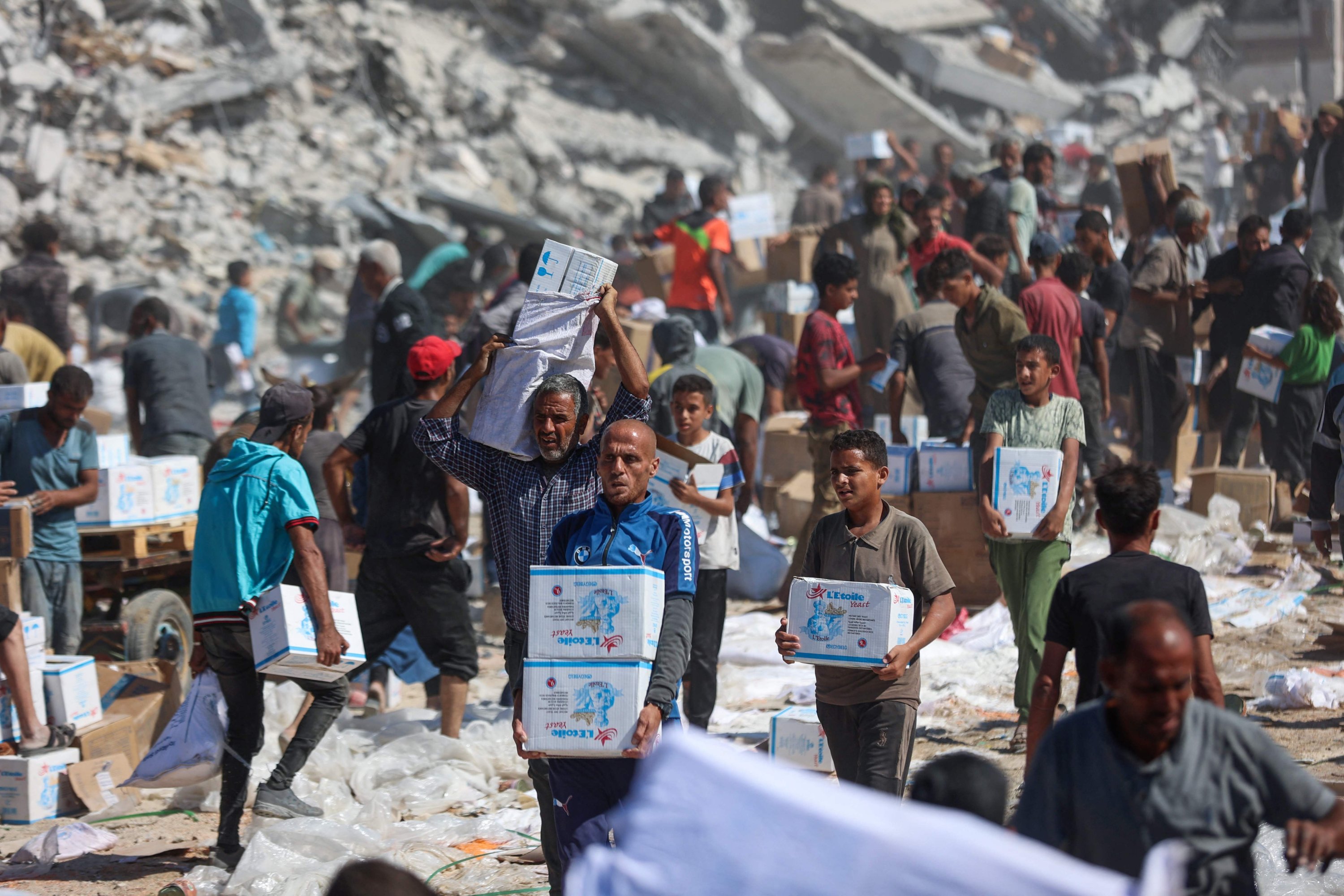
The U.N. and the International Red Cross on Tuesday urged the opening of all Gaza crossings to enable the delivery of desperately needed aid to the war-torn territory.
A fragile truce in Gaza, introduced under U.S. President Donald Trump's plan, needs to see crossings opened to flood the famine-hit territory with aid, they said.
"That's what humanitarians, including ICRC, have been calling for in the last hours is making sure that, because of the huge needs, all entry points can be open," Red Cross spokesman Christian Cardon told reporters in Geneva.
The U.N. humanitarian agency OCHA's spokesman Jens Laerke added: "We need all of them open."
He acknowledged that not all of the crossings were currently "functional," with some "partially destroyed," while road clearance was needed inside Gaza to allow trucks in.
"We are calling for that to be repaired so that they can become operational," he said.
"We're advocating with everyone."
On Aug. 22, the U.N. declared a famine in Gaza, the first in the Middle East, after experts warned 500,000 people faced a "catastrophic" threat.
Earlier Monday, the WHO director-general said that the organization is scaling up operations in Gaza.
The WHO has "deployed an emergency medical team within 24h to boost surgical and emergency care at Al-Ahli Hospital, with more deployments planned in Gaza City as people begin to return" and "brought 8 trucks of medical supplies into Gaza, including insulin, lab supplies and essential medicines," Tedros Adhanom Ghebreyesus said on X social media.
The WHO also reached the European Gaza Hospital to collect cancer medicines and other life-saving supplies, including intensive care equipment such as incubators, mechanical ventilators and patient monitors, Tedros said.
These items were subsequently delivered to Nasser Hospital, he added.
"Improving access to health facilities and expanding our operational missions are vital first steps toward delivering urgent health assistance to Palestinians throughout Gaza," he added.
The initial release of Israeli hostages and Palestinian detainees offers a sense of hope to all who have endured immense suffering over the past two years, Tedros noted.
The developments of this week represent "an important step in the right direction," he said, stressing the WHO's readiness to significantly augment its efforts to save lives and restore essential health services.
Gaza's health system must not only be restored but also rebuilt to be stronger, more equitable and responsive to people's needs, he said.
"The best medicine is peace," he added.
The first phase of the Gaza cease-fire agreement took effect Friday under U.S. President Donald Trump's plan to end Israel's two-year genocidal war on the enclave.
Earlier Monday, the release of Palestinians imprisoned in Israeli jails began after Hamas freed all 20 living Israeli captives held in the Gaza Strip.
Since October 2023, Israeli attacks have killed more than 67,800 Palestinians in Gaza, most of them women and children, leaving the enclave largely uninhabitable.