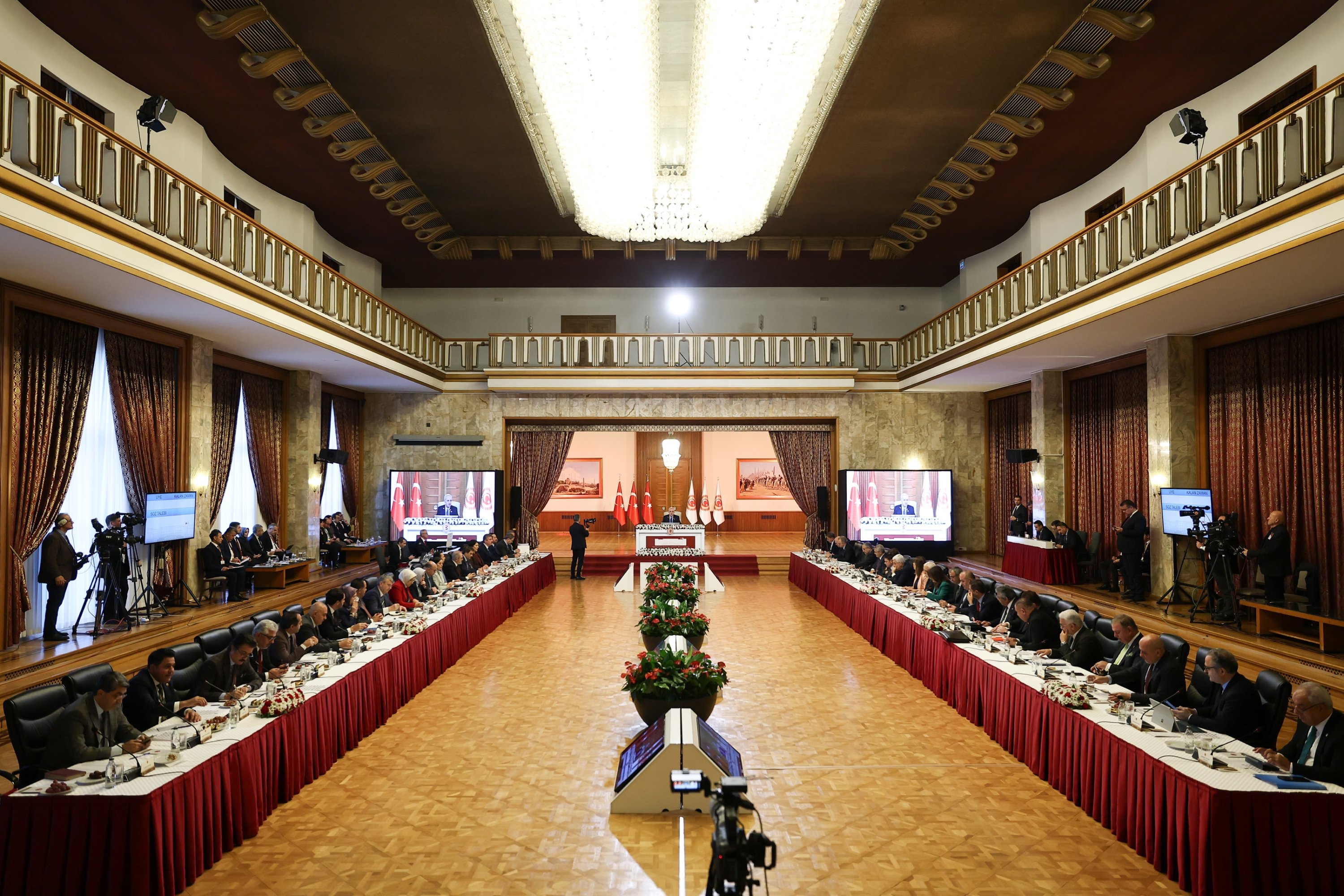
Türkiye's political parties represented on the National Solidarity, Brotherhood and Democracy Committee have submitted their reports one by one. It will not be easy for the commission to distill these reports into a single document and present it to the Parliament. The reason is clear. Unfortunately, opposition parties have failed to put forward concrete proposals within a tangible framework aimed at ending terrorism, including the transition period and its aftermath.
The main opposition Republican People's Party's (CHP) report bears little relevance to the goal of a “terror-free Türkiye.” Anyone who reads the report can easily see that the CHP does not, in fact, have a genuine policy aimed at ending terrorism. Lacking a well-developed strategy, the report narrows its focus to how the party might extricate itself from corruption and bribery allegations involving CHP-run municipalities. Its demands regarding democracy, the rule of law, and judicial processes are essentially framed as solutions to the CHP’s own internal problems.
Until now, the CHP had consistently pointed to the Parliament as the proper address for steps to end terrorism, stating that it had things to say on this issue in Parliament. In line with this demand – and with the objective of achieving a “terror-free Türkiye” – Parliament assumed responsibility. However, as can be understood from its report, the CHP appears to have had no real preparation on this matter. Broadly speaking, the CHP’s institutional approach is shaped primarily as a reaction to the government’s proposals.
Reading the Peoples' Equality and Democracy Party's (DEM Party) report, it is difficult not to conclude that it was written in a way that complicates the process. The DEM Party has once again expressed its views on all of Türkiye’s issues using organizational jargon. It would not be surprising if the DEM Party were to prepare a report on whether there is life in outer space and still say much the same things. Nearly every issue is reduced to Imralı island, with references to the PKK's imprisoned leader Abdullah Öcalan appearing several times on almost every page. In its report, the DEM Party fails to position itself as an actor while listing virtually every maximalist demand, whether relevant to the issue at hand or not.
The proposals in the reports submitted by the parties of the People's Alliance are largely aligned. Particularly with regard to disarmament, the transition period, and what follows, both reports concretely outline a roadmap and comprehensively explain the principled and institutional thresholds that specify what will be done and when. Both parties emphasize that the process is being conducted as a holistic state policy, and the red lines that had previously been expressed verbally are once again clearly articulated in writing.
Since the “terror-free Türkiye” objective was put back on the agenda, one of the main criticisms directed at the government has been that planning, the roadmap, and red lines were not fully communicated to the public. In this context, the ruling Justice and Development Party's (AK Party) report concretizes three critical issues.
First, in political and legal steps to be taken, a mechanism of determination and verification is defined as a fundamental precondition. The terrorist organization’s laying down of arms and self-dissolution must be determined by the state in an objective, measurable manner, based on concrete evidence and subject to judicial oversight – this is presented as an indispensable condition.
Second, the report clearly explains what is meant by the goal of a “terror-free region,” which complements the objective of a “terror-free Türkiye.” It underscores that Türkiye’s security cannot be ensured solely through domestic dynamics and emphasizes determination to rid Syria and Iraq of PKK terrorism as well.
Finally, it is proposed that the legal foundation of the process be established through a “separate and temporary law.” The importance of this approach lies in the fact that it is specific to the dismantling process and does not strain the ordinary legal order. The law’s limited duration and scope are significant in ensuring that the exceptional nature of the process does not become permanent.
The People's Alliance’s reports’ references to both Turkish and international experiences, as well as their cautious approach aimed at avoiding past mistakes, are noteworthy for the soundness of the process. In this context, if the goal of a “terror-free Türkiye” is achieved, it will have been accomplished through a unique model.
The commission will draft its general report this week. As noted at the outset, it will not be easy for the commission to reach consensus on a single report. However, in order to overcome the challenges and differences in approach, it would be beneficial for the general report to be concise, principle-focused, and directly centered on the transition process aimed at ending terrorism.