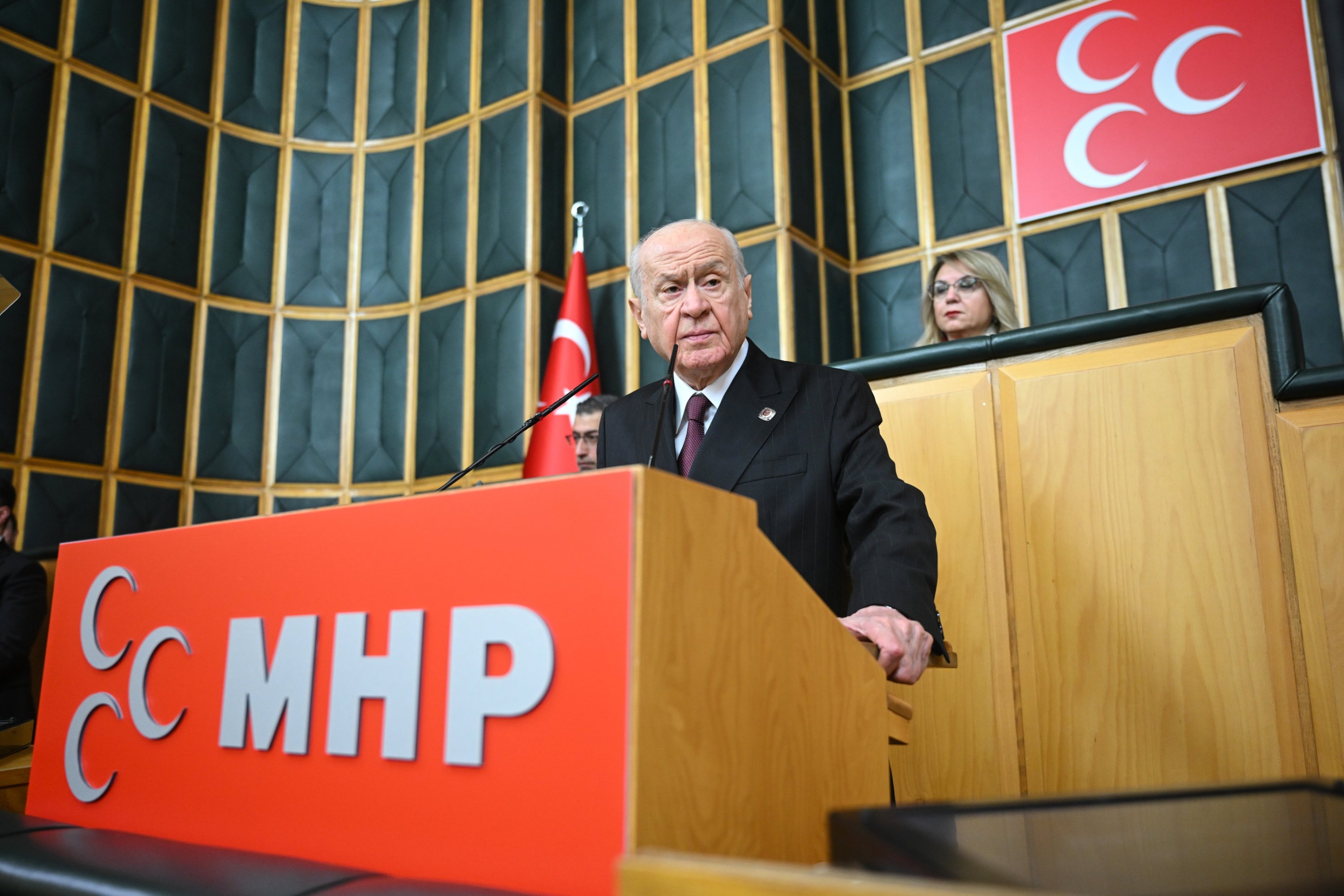
Nationalist Movement Party (MHP) leader Devlet Bahçeli addressed his party’s parliamentary group meeting on Tuesday, focusing largely on the ongoing tensions involving the United States, Israel and Iran and support for the Iranian people.
In his speech, Bahceli strongly criticized what he described as attacks against Iran, calling them immoral and urging support for the Iranian people. “In the face of this immoral aggression, it is time to stand for justice and law, and to stand with the people of Iran against Zionist oppression,” he said.
He emphasized Türkiye’s close historical and cultural ties with Iran, describing it as “not just a neighbor but a country of religious and linguistic kin.” Bahçeli called on the international community to stand against what he described as injustice and to support diplomatic efforts led by Türkiye.
Highlighting the risks of further escalation, Bahçeli warned that attacks on energy infrastructure, including oil facilities and transit routes, could trigger global economic disruptions. He pointed specifically to threats to key waterways such as the Strait of Hormuz and Bab al-Mandeb, saying increased military activity could deepen energy security risks and strain supply chains.
Bahçeli also described Israel’s actions in Gaza, as well as toward Iran and Lebanon, as “aggressive policies” that have turned the region “into a hell,” and argued that Israel poses a serious threat to international peace and stability. He also claimed that perceptions of U.S. Middle East policy being influenced by Israel have fueled growing backlash among Western and American publics.
Turning to Washington, Bahçeli urged U.S. President Donald Trump to take into account anti-war protests and restrain Israel, saying Trump had come to power promising to end wars but instead contributed to “destruction that will be difficult to repair.”
Moreover, he also criticized the international system as ineffective, saying global institutions, including the United Nations, have failed to prevent escalating violence. He warned that rising tensions, weakened diplomacy and even suggestions of nuclear confrontation signal a dangerous trajectory.
“The world must adopt a common stance against war,” Bahçeli said, calling for an immediate cease-fire and renewed diplomatic engagement.
“There will be no winners in this conflict, but innocent people everywhere will bear its consequences.”
The U.S. and Israel launched a large-scale military campaign against Iran on Feb. 28, 2026, targeting the country’s leadership, nuclear program and military infrastructure, triggering a rapidly escalating regional conflict marked by sustained airstrikes, retaliatory attacks and mounting civilian casualties.
Bahçeli accused European countries of turning a blind eye to the “aggressive policies” of the Greek Cypriot administration, which he said has been strengthened through arms shipments. He stressed that Türkiye cannot ignore threats to its kin in the Turkish Republic of Northern Cyprus (TRNC), describing the island as “not a routine foreign policy matter but a national cause and an indispensable sovereignty issue.”
Highlighting broader global risks, Bahçeli said the world is “on the brink of political, economic and humanitarian upheaval,” citing uncertainties in energy security, food supply, migration flows and trade routes. He argued that these crises are not accidental but rather the result of a new imperialist drive to control global resources and expand spheres of influence, with innocent populations paying the price.
Bahçeli added that, amid statements by some circles in Israel portraying Türkiye as a “new target,” it is historically and strategically necessary for Türkiye to remain strong, resilient and united internally. He warned that any attempts to weaken the country’s internal front through rhetoric, actions or provocations directly threaten national security.
“Türkiye cannot be governed through short-term political debates, cheap calculations or irresponsible statements,” Bahçeli said.
Bahçeli’s remarks came amid the rising tensions in the Middle East and growing military cooperation between the Greek Cypriot administration and its Western partners.
According to Greek Cypriot and Greek media reports, two Greek frigates have recently arrived in waters controlled by the Greek Cypriot administration.
European countries also pledged to send air defense systems and other military assets to the Greek Cypriot administration, while France deployed an aircraft carrier, a frigate and air defense units to the Mediterranean.
Bahçeli noted that the “National Solidarity, Brotherhood, and Democracy Commission,” established within the Grand National Assembly of Türkiye, has completed its work, producing a joint commission report and laying the groundwork for societal consensus. He said the next step is to swiftly enact laws that support the project’s objectives.
Bahçeli stressed that national unity and solidarity will be Türkiye’s most effective response to hostile attempts. He described the "terror-free Türkiye" initiative as a “guiding star” for the state and society, highlighting the need for all political actors and community segments to act carefully and avoid provocations.
Bahçeli warned that certain foreign capitals and intelligence networks are attempting to exploit societal divisions through voluntary or paid agents, but he underlined that Türkiye’s goal remains the creation of a more democratic, effective, stable, and prosperous nation.
“Our aim and effort is to disrupt external schemes and shape a future where our people lead the story, rejecting imperialist agendas,” he said. Bahçeli added that the terror-free Türkiye goal, seen as a historic opportunity for the country and region, will be realized through strong social support and political determination.