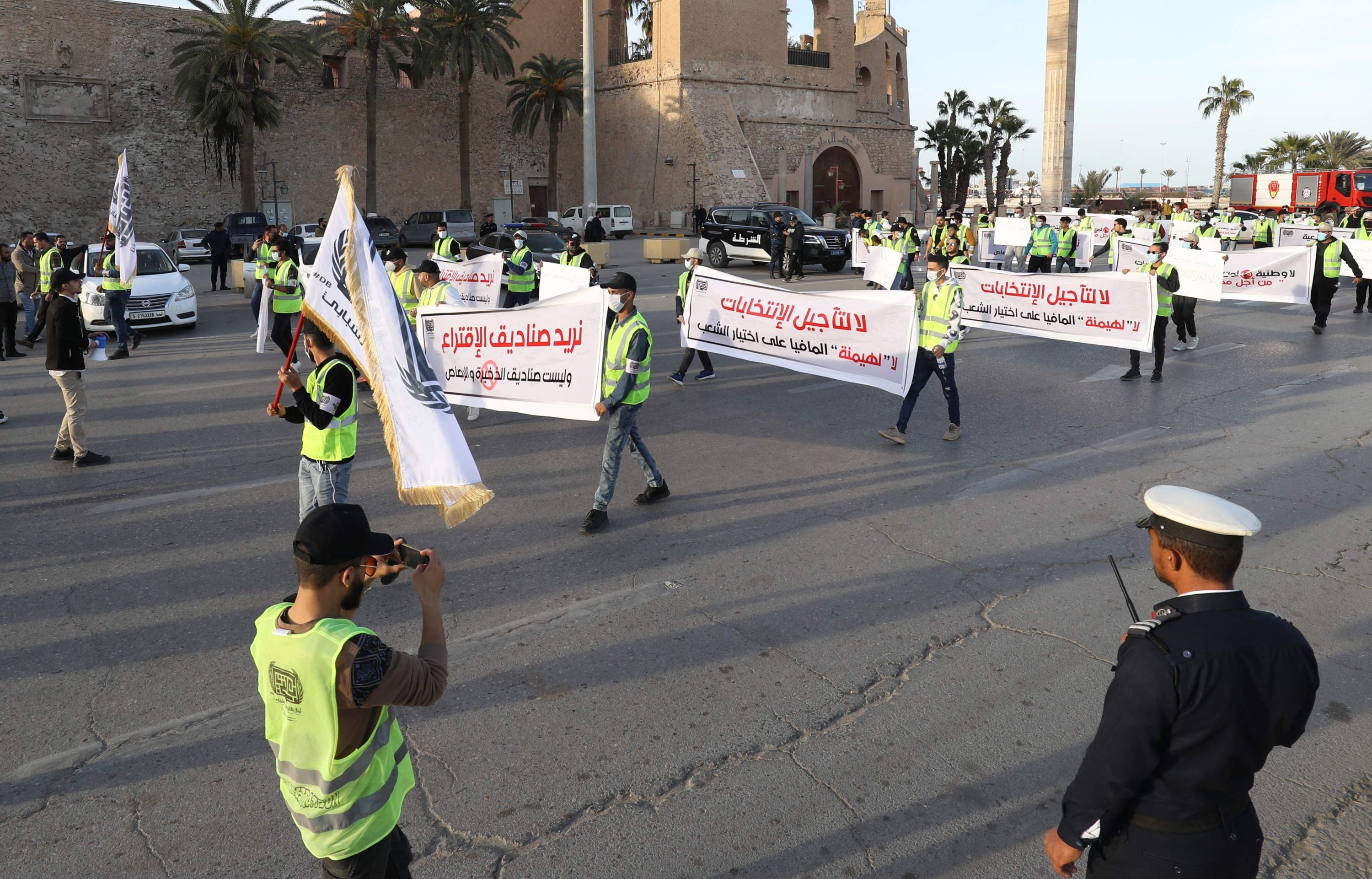
While Libya was unable to hold its first presidential election as planned this month in a major blow to international efforts to end a decade of chaos in the oil-rich Mediterranean country, the failure to hold the vote as planned threatens to open a political vacuum.
The postponement of the Dec. 24 vote has opened up uncertainty over what comes next in the tenuous peace process, raising concern that Libya could slide into a new round of violence after more than a year of relative calm.
The planned vote was the lynchpin of international peace efforts, and major regional and international powers had for months pushed for it to take place as scheduled.
But many inside and outside Libya doubted the election would proceed as planned. Some warned that holding the vote could destabilize the country, given the continued polarization.
Libya descended into chaos following the 2011 NATO-backed uprising that ousted and then killed longtime leader Moammar Gadhafi. Since then, armed groups have proliferated, including local and tribal militias, nationalist and mainstream groups, and the al-Qaida and Daesh terrorist groups.
Since parliamentary elections in 2014, the country has been divided between two main rival administrations: one in the east backed by military commander putschist Gen. Khalifa Haftar, mainly backed by Egypt, the United Arab Emirates (UAE), Russia and France, and another in the west – the United Nations-recognized Government of National Accord (GNA) in the capital Tripoli, mainly backed by Turkey and Qatar
Turkey and Libya have seen closer ties in recent years, especially after the signing of security and maritime boundary pacts in November 2019, along with Turkey’s aid to help the legitimate Libyan government push back putschist Haftar’s forces.
Haftar, who was a senior officer under Gadhafi but defected in the 1980s, is based in the eastern city of Benghazi, the epicenter of the 2011 uprising. His forces control much of eastern and southern Libya, including its oil fields and terminals. In April 2019, Haftar and his forces launched an offensive on Tripoli, but Turkey and Qatar stepped up their military support for his Tripoli-based rivals. The offensive failed after 14 months of fighting.
An internationally brokered October 2020 cease-fire has kept a relative peace since. But some of its main provisions – the withdrawal of all foreign forces and mercenaries within three months and adherence to a U.N. arms embargo – have not been met.
After the cease-fire deal, the U.N. led a political process called the Libyan Political Dialogue Forum, which includes 75 delegates from across the country.
The forum set presidential and parliamentary elections for Dec. 24. It also appointed an interim government that included a three-member Presidential Council led by an eastern figure, and a Cabinet led by Prime Minister Abdul Hamid Mohammed Dbeibah, a powerful businessperson from the western city of Misrata. The interim government’s main task was to prepare the country for the elections.
From the beginning, the process was hampered by disputes. The main leadership body in the west, the Tripoli-based Supreme Council of State, denounced the rules governing the election, drawn up by the eastern-based parliament. Dbeibah joined the criticism. With legal challenges over the rules still unresolved, the Council of State persistently called for the vote to be delayed.
Mistrust deepened when lawmakers decided to hold parliamentary elections a month after the planned Dec. 24 presidential vote, rather than simultaneously.
The presidential election became sharply polarized when several figures who were considered intolerable by their opponents declared their intention to run – particularly Haftar and Seif al-Islam Gadhafi, the ousted dictator's son and one-time heir apparent.
Seif al-Islam’s declaration of his candidacy prompted vows from opponents never to allow a return of Gadhafi family rule. The election commission disqualified him along with two dozen other would-be candidates. But on appeal, courts restored most of them, including Seif al-Islam.
Dbeibah also declared his candidacy, causing outrage because when he was appointed to the head of the transitional government, he had promised not to run.
Around 100 people submitted documents to run for president, but with legal disputes still roiling, the election commission was unable to declare a final list of candidates.
It was also never clear what would happen after the elections. All sides agree the Libyan Constitution needs to be rewritten, but there has been no agreement on who will do so or when.
With so much at stake and so much still unresolved, militias showed their discontent. Militias demanding a postponement blocked roads in parts of Tripoli, raising warnings from the U.N. mission in Libya that the tensions could explode into violence.
And each side in the country’s main east-west split remains ready for a fight, bolstered by mercenaries provided by their foreign backers who have not withdrawn. The current number of mercenaries is not known, but according to the U.N., they have numbered as high as 20,000.
The failure to hold the vote as planned threatens to open a political vacuum.
Lawmakers have argued that the interim government’s mandate ended on Dec. 24. They say the government failed in its main tasks, preparing the country for the vote, unifying its institutions and dismantling militias or integrating them into regular security forces.
Dbeibah, the interim prime minister, said in a televised address Tuesday that he and his administration would remain until “real elections” are held. He said the election laws were “flawed” and called for the vote to be based on a newly drafted constitution.
Major Western governments have called for the government to remain in power until “prompt” parliamentary and presidential elections are held. The election commission proposed Jan. 24 as a new date.
But it’s not clear when or if the factions can resolve the disputes that led to the failure to hold the vote as planned. Stephanie Williams, the U.N. special adviser on Libya, has for two weeks shuttled between major Libyan players.
A legislative committee for the election blamed militias that it said wanted “to craft a distorted electoral process,” an apparent reference to complaints from Tripoli over the election rules.
The committee suggested drawing a “practical road map” for elections and restructuring the interim government to “achieve stability,” without specifying dates.
More than 100 lawmakers held two days of deliberations this week in the eastern city of Tobruk over the future of the electoral process and the interim government. The session ended without a decision and is expected to continue next week.